Vastu Shastra: Directions, Zones and Home Layout Rules
Vastu Shastra is the traditional Indian system of architecture: a floor plan is divided from its centre into directional zones, each tied to an element, and rooms are judged by whether they sit in a zone that suits their use. This page is GetMyVastu’s written Vastu Shastra guide for directions, 16 zones and layout rules. To check your own house, upload the floor plan on the homepage for a Vastu report.
The five elements of Vastu Shastra
Vastu assigns each of the five elements (Pancha Bhoota) to a part of the building. The aim is to place each activity in a zone whose element supports it.
| Element | Zone | What it governs |
|---|---|---|
| Earth (Prithvi) | South-West | Stability, weight and relationships. Heavy storage and the master bedroom are traditionally placed here. |
| Water (Jal) | North-East | Clarity, growth and learning. Kept open, light and uncluttered; underground water tanks and prayer spaces belong here. |
| Fire (Agni) | South-East | Energy, digestion and transformation. The kitchen and other heat sources are placed in this zone. |
| Air (Vayu) | North-West | Movement and change. Suits guest rooms, storage of moving goods, and anything meant to circulate rather than settle. |
| Space (Akasha) | Centre (Brahmasthan) | The balancing centre. Traditionally left open and unloaded — no heavy structure, staircase or toilet. |
The eight directions and what they govern
The eight primary directions are measured from the centre of the plan, not from a wall. Each carries a governing deity in the tradition and a set of uses it is considered to suit.
| Direction | Deity | Governs | Suited to |
|---|---|---|---|
| North (Uttara) | Kubera | Wealth, career and opportunity | Living room, office, cash storage |
| North-East (Ishanya) | Ishana / Shiva | Clarity, wisdom, spirituality | Prayer room, open space, water source |
| East (Purva) | Indra | Health, social connection, new beginnings | Main entrance, living areas, windows |
| South-East (Agneya) | Agni | Fire, energy, metabolism | Kitchen, electrical equipment |
| South (Dakshina) | Yama | Rest, discipline, endurance | Bedroom, heavy storage |
| South-West (Nairutya) | Nirriti | Stability, relationships, strength | Master bedroom, heavy furniture |
| West (Paschima) | Varuna | Gains, results, recognition | Dining room, children's study |
| North-West (Vayavya) | Vayu | Movement, support, networking | Guest room, storage, toilets |
16 Directional Panchatatva & Room Attributes
| Direction | Degrees | Element | Deity | Ideal Placements | Avoid |
|---|---|---|---|---|---|
| North (N) | 348.75° - 11.25° | Water | Kuber / Mukhya | Living, Entrance, Safe | Toilet, Kitchen |
| North-East (NE) | 33.75° - 56.25° | Water | Ishan | Pooja, Meditation, Study | Toilet, Master Bedroom |
| East (E) | 78.75° - 101.25° | Wood | Indra / Jayanta | Main Entrance, Living | Toilet, Heavy Storage |
| South-East (SE) | 123.75° - 146.25° | Fire | Agni | Kitchen, Electricals | Water Tank, Bedroom |
| South (S) | 168.75° - 191.25° | Fire | Yama | Bedroom, Relaxation | Main Entrance, Water |
| South-West (SW) | 213.75° - 236.25° | Earth | Pitra | Master Bedroom, Heavy Safe | Toilet, Kitchen, Entrance |
| West (W) | 258.75° - 281.25° | Space | Varun | Dining, Study, Children | Kitchen, Toilet |
| North-West (NW) | 303.75° - 326.25° | Space | Vayu | Guest Room, Finished Goods | Master Bedroom |
Why direction matters so much: the same floor plan rotated 90° produces an entirely different zone map. Every Vastu reading is only as reliable as the North direction it started from.
From 8 zones to 16 and 32
Classical Vastu works with eight directions. Modern Mahavastu practice subdivides these into sixteen sectors of 22.5° each, and further into thirty-two for detailed placement work. The finer the grid, the more precisely a room’s position can be read — two rooms that both look “North” on an 8-zone map can fall in different 16-zone sectors with different recommended uses. Our guide to the 8, 16 and 32 zone systems works through the differences with examples.
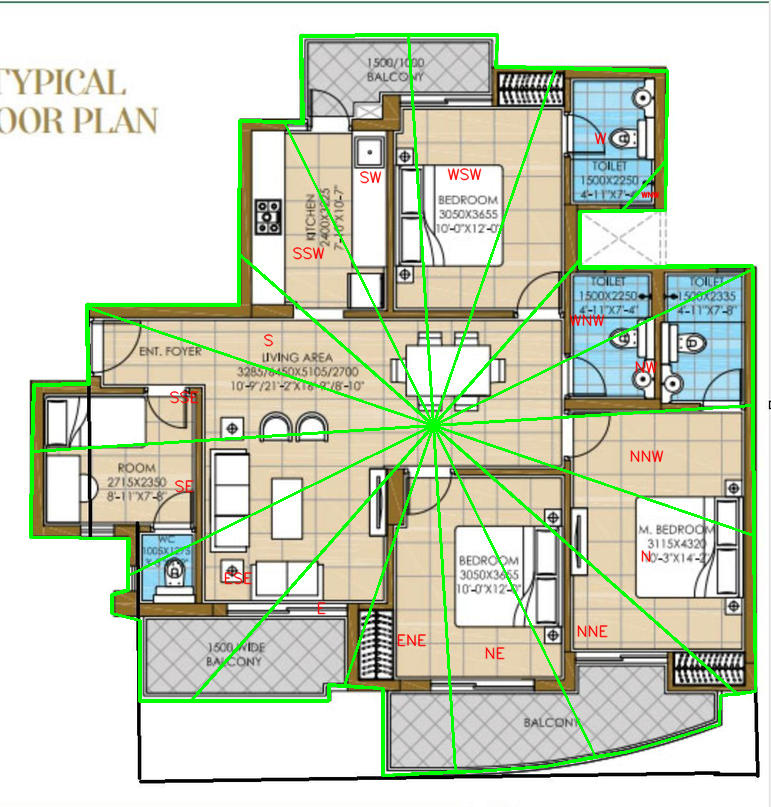
Room placement at a glance
- Kitchen — South-East (fire zone) is the primary recommendation; North-West is the usual alternative. Best direction for kitchen as per Vastu
- Master bedroom — South-West, the earth zone associated with stability. Bedroom Vastu in detail
- Prayer room — North-East, kept light and uncluttered.
- Toilets — North-West or West; avoid the North-East and the Brahmasthan.
- Centre (Brahmasthan) — keep open. No staircase, toilet or heavy structure.
- Main entrance — North, North-East or East are traditionally favoured. North-facing house guidelines
Common Vastu defects — and what to do about them
A Vastu defect (Vastu dosha) is simply a mismatch between a zone and what has been placed in it: a toilet in the North-East, a kitchen in the North-East instead of the South-East, a heavy staircase through the centre, or a missing corner in the plot. In a finished home most of these can be reduced without breaking walls — by moving the function, adjusting colour and material towards the zone’s element, or redistributing weight. See Vastu defects and remedies without demolition.
How a Vastu score is calculated
A Vastu score condenses the analysis into a single 0–100 number. The approach that holds up is area weighting: for each room, measure what percentage of it overlaps each directional zone, score each zone for that room’s use, weight by overlap area, then combine rooms by importance. A room that barely clips an unfavourable zone should not count the same as one sitting squarely inside it. Full explanation of the Vastu score.
Ayadi (Ayaadi): the dimensional layer
Directional zones are not the whole of classical Vastu. Ayadi — also spelled Ayaadi or Aayadi — applies a six-fold proportion test to the plot or building’s actual measurements, converted into traditional hasta units, producing Aaya, Vyaya, Yoni, Nakshatra, Vaara and Tithi factors. It says nothing about room placement — it tests proportion. You can run it free on our free Ayadi calculator, or read how Ayaadi calculation works.
How to check Vastu of your own home
- Get a floor plan drawn to scale.
- Establish true North for the property.
- Mark the plan boundary and find its centre.
- Measure directional zones outward from that centre.
- Note which zone each room occupies and compare against its use.
- Prioritise the mismatches that affect rooms you use most.
Doing this by hand is slow and easy to get wrong. GetMyVastu does it from an uploaded plan in minutes — see the step-by-step guide or what you can check for free first.
Apply this to your own floor plan
Upload your plan, confirm North, and get the 8, 16 and 32-zone maps, a Vastu score and zone-wise remedies as a PDF. From ₹99.
Get my Vastu reportFrequently asked questions about Vastu Shastra
What is Vastu Shastra?
Vastu Shastra is the traditional Indian system of architecture and spatial design. It defines how a building should be oriented and how rooms should be arranged so the layout works with natural forces — sunlight, prevailing wind, magnetic orientation and the five elements. A Vastu analysis divides a floor plan into directional zones measured from its centre and checks whether each room sits in a zone suited to its use.
How does Vastu Shastra apply to a house layout?
Applied to a house, Vastu Shastra is a zone reading: bedroom, kitchen, toilet and entrance are judged from the centre of the floor plan, aligned to North. This page is the written guide. For a check of your own home, use the GetMyVastu homepage report on the layout you upload.
What are the five elements in Vastu Shastra?
The five elements (Pancha Bhoota) are earth (Prithvi, South-West), water (Jal, North-East), fire (Agni, South-East), air (Vayu, North-West) and space (Akasha, the centre or Brahmasthan). Each governs a zone of the building, and Vastu aims to keep activities in zones whose element supports them — for example the kitchen in the fire zone and the master bedroom in the earth zone.
What are the 16 zones in Vastu Shastra?
The 16-zone system (used in Mahavastu) subdivides the eight primary directions into sixteen sectors of 22.5° each, measured from the centre of the plan. It gives a finer reading than the 8-direction model: two rooms that both appear to be in the North can sit in different 16-zone sectors with different recommended uses. Analysis can be taken further to 32 zones for more granular placement work.
Which direction should a house face as per Vastu?
North, North-East and East facing entrances are traditionally considered most favourable, because they admit morning light. That said, no facing direction is automatically bad. What matters more is the internal layout: where the kitchen, master bedroom, toilets and Brahmasthan fall relative to the plan's centre. A south-facing house with a well-arranged interior can test better than a north-facing house with a toilet in the North-East.
Is Vastu Shastra scientific?
Vastu Shastra is a traditional architectural system, not a modern experimental science. Some of its principles have straightforward practical explanations: orientation determines how much morning versus afternoon sun a room receives, which genuinely affects temperature, light and ventilation. Other rules — directional deities, pada grids and remedies — belong to the tradition rather than to empirical research. Treat a Vastu report as one input into design decisions, not as structural, medical, legal or financial advice.
Can Vastu defects be fixed without demolition?
In most finished homes, yes. A Vastu defect is a mismatch between a zone and the activity placed in it, and many mismatches can be reduced by changing what happens in the space rather than the walls: relocating a function to a better zone, adjusting colours and materials towards the zone's element, adding or removing weight, and clearing the centre. Structural changes are a last resort, which is why non-demolition remedies are the practical starting point.
How do I check Vastu of my house?
You need two things: a floor plan drawn to scale and the correct North direction. Mark the plan's boundary, find its centre, then measure directional zones outward from that centre and note which zone each room falls in. Doing this by hand is slow and easy to get wrong, which is why an online tool that overlays the zone grid on your uploaded plan is faster and more consistent.
What is the Brahmasthan in Vastu?
The Brahmasthan is the central zone of a plot or building, associated with the element of space. Tradition holds that it should stay open and unloaded — no heavy structure, staircase, toilet or pillar — so that the rest of the layout stays balanced around it. A toilet or staircase in the Brahmasthan is one of the more commonly flagged defects in a Vastu report.
All Vastu guides
- How to Check Vastu of Your House: A Step-by-Step Guide
- North Facing House Vastu: Complete Guidelines and Room Placement
- Bedroom Position as per Vastu: Best Direction and Layout
- What Does a Vastu Report Include? Everything You Need to Know
- Best Direction for Kitchen as per Vastu: Stove Position and Placement
- Vastu Zones Explained: 8, 16, and 32 Directional Zones
- What Is a Vastu Score and How Does It Work?
- Vastu Calculator Online: How to Check Your Home's Vastu in Minutes
- Floor Plan Vastu Analysis: How to Read Your House Map Correctly
- Vastu Check Before Buying a House: A Buyer's Checklist
- Vastu Defects and Remedies: Fixing Problems Without Demolition
- Vastu Gridding Explained: How to Grid a Floor Plan for Vastu
- Ayaadi Calculation in Vastu: Plot Proportion, Nakshatra and Aaya
- East Facing House Vastu: Entrance, Kitchen and Bedroom
- West Facing House Vastu: Entrance, Kitchen and Bedroom
- South Facing House Vastu: Entrance, Kitchen and Bedroom
- Toilet and Bathroom Position as per Vastu
- Pooja Room Direction as per Vastu
- Living Room Position as per Vastu
- Main Door and Entrance Vastu: Pada, Direction and Height
- Vastu Check Online vs Hiring a Vastu Consultant
- GetMyVastu vs Drawing a Vastu Grid by Hand
- What is a Vastu Webinar and Why Should You Attend One?
- Free Vastu Classes Online: Where to Learn Vastu for Free in 2026
- How to Choose the Right Vastu Webinar: Checklist for Learners
Vastu Shastra is a traditional architectural system. This guide is informational and is not structural, engineering, legal, medical or financial advice. For guidance on a specific property, consider a Vastu consultation.