16 Vastu Zones and the Vastu Chakra: 8, 16 and 32 Directional Grids
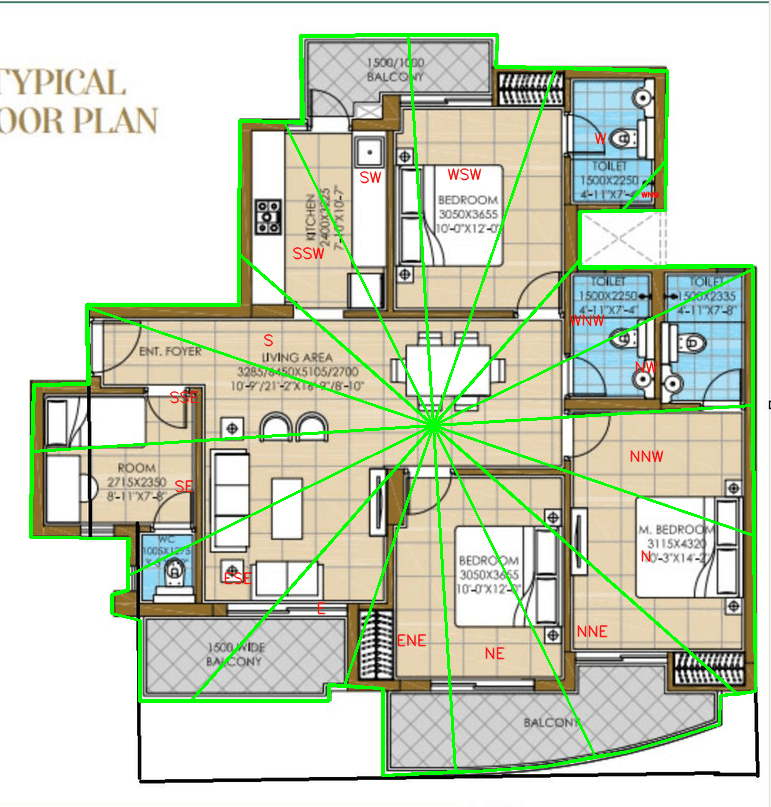
The 16 Vastu zones are the room-level reading of a house: each of the eight directions split in two, drawn as a Vastu chakra (zone chart) from the plan's centre. 8 zones is the overview; 32 zones is for entrances and fine placement. The image below is the 16-zone Vastu chakra used in a GetMyVastu report.
What is a Vastu chakra?
A Vastu chakra is the directional zone chart drawn on a floor plan. It is the same idea as a Vastu map or Vastu chart: rooms are read against the sector they occupy once the grid is centred and pointed North. GetMyVastu uses the 16-zone Mahavastu chakra on the free plan; the Shakti Chakra is the paid overlay on the same layout.
Why Directional Zones Matter
Vastu Shastra is fundamentally a science of direction and proportion. The idea is that different directions carry different elemental energies — North is water and wealth, South-East is fire, North-East is space and spirituality, South-West is earth and stability — and the activities and rooms you place in each direction either harmonise with or conflict against that energy.
The zone system is how you translate these abstract directional principles into your actual floor plan. You overlay a directional grid on the plan, assign each room or area to a zone, and then evaluate whether the use of each space matches the zone's governing energy.
8 Zones: The Ashtadisha Overview
The 8-zone system uses the eight cardinal and inter-cardinal directions: N, NE, E, SE, S, SW, W, NW, plus the centre (Brahmasthana). This is the traditional Ashtadisha (eight directions) system and is the starting point for any Vastu assessment.
| Zone | Element | Deity | Governs |
|---|---|---|---|
| North (N) | Water | Kubera | Wealth, career, financial inflow |
| North-East (NE) | Space | Ishaan / Shiva | Spirituality, clarity, prayer |
| East (E) | Air/Sun | Indra | Social life, health, opportunities |
| South-East (SE) | Fire | Agni | Energy, cooking, transformation |
| South (S) | Earth | Yama | Discipline, order, structure |
| South-West (SW) | Earth | Niruti | Stability, master bedroom, longevity |
| West (W) | Air/Metal | Varuna | Gains, enjoyment, results |
| North-West (NW) | Air | Vayu | Movement, guests, short stays |
| Centre | Space | Brahma | Energy hub — must remain open |
The 8-zone analysis is ideal for plot selection, comparing properties, or getting a fast read on a home before committing to more detailed work.
16 Zones: The Room-Level System
The 16-zone system divides each of the eight directions into two sub-zones, giving 16 sectors around the perimeter of the floor plan. This is the most practically useful level for homeowners — it maps individual rooms to specific zones with enough precision to make meaningful recommendations.
For example, the North direction splits into:
- North of North (NNW): Associated with savings, preservation, and Kubera's treasury energy.
- North of East (NNE): Associated with new opportunities, social connections, and incoming positive energy.
This distinction matters for room placement. A cash drawer in the NNW sub-zone of North reinforces the savings energy of that position. A living room that opens into the NNE sub-zone is better positioned for social activity than one in the NNW.
16 zones is the right level for most homeowners. It gives actionable zone assignments for every room without requiring the architectural precision that 32-zone analysis demands.
32 Zones: Vedic and Moderne Vastu
The 32-zone system is used for detailed design work — doorway placement, entrance positioning, and fine-grained analysis of where specific furniture, stairs, or structural elements should go. It comes in two variants:
Vedic Vastu (Traditional)
The traditional Vedic system divides the perimeter of the plot into 32 positions called padas (steps). Each pada is 11.25° of the compass arc and is governed by a specific Vastu deity. This system is primarily used to determine the most auspicious entrance positions on any wall of the house.
Moderne Vastu
Moderne Vastu is a contemporary adaptation that divides the floor plan into 32 zones using a grid overlay rather than just the perimeter. It creates a more granular energy map of the interior space, allowing analysis of which part of each room sits in which zone — useful for furniture placement and interior design decisions.
How Zone Size Affects the Analysis
An important but often overlooked aspect of zone analysis is proportionality. A room that occupies 5% of the floor plan has much less zone impact than one that occupies 30%.
This is why area bar charts are a key part of a complete Vastu report. They show what proportion of your floor plan sits in each zone, so you can see at a glance whether any zone is disproportionately dominant — for example, if 45% of the home's area is in the South-West (very stable and grounded) versus 5% in the North-East (very light and spiritual), this imbalance has a distinct character.
Which Zone Level Should You Use?
| Situation | Recommended Level |
|---|---|
| Comparing properties before buying | 8 zones |
| Analysing your current home for room-use conflicts | 16 zones |
| Planning furniture placement and room flow | 16 zones |
| Planning a new build or major renovation | 32 zones |
| Positioning doorways and main entrance exactly | 32 zones (Vedic) |
| Interior design decisions within rooms | 32 zones (Moderne) |
A complete GetMyVastu report includes all three levels — 8, 16, and 32 zones — in a single downloadable PDF, so you have the full picture from overview to fine detail.
See all three zone levels for your home
Upload your floor plan and get an 8, 16, and 32-zone Vastu analysis with area charts, Mahavastu Shakti Chakra overlay, and a downloadable PDF.
Get my Vastu reportFrequently asked questions
What are the 16 Vastu zones?
The 16 Vastu zones split each of the eight directions into two sectors of 22.5°. Measured from the plan's centre and aligned to North, they are the practical room-level grid: two rooms that both look 'North' on an 8-zone map can sit in different 16-zone sectors.
What is a Vastu chakra?
A Vastu chakra (also called a Vastu chart or zone map) is that directional grid drawn over a floor plan. On GetMyVastu the 16-zone Mahavastu chakra is the free overlay; the Mahavastu Shakti Chakra is a paid extra on the same plan.
What is the difference between 8, 16 and 32 Vastu zones?
8 zones is the eight directions plus the centre — good for comparing plots. 16 zones is the room-level reading most homeowners need. 32 zones (padas) is for entrance position and fine placement. A full GetMyVastu report includes all three.